
The English barn on the Lape farm has been through several transformations reflecting the vagaries of Fred’s financial circumstances. No part of this old structure is more revealing of Fred Lape’s character than the studio which was located at the eastern end. In the 1940s, when he was forced to return to subsistence farming, to return his barn, within the span of one summer, to its original purpose of storing hay and sheltering animals for the winter, Fred could not bear to tear out his beloved studio. “(Its) construction pleased me too much to give up.” (From The Year Everything Changed by F. Lape. Unpublished).
In the early 1930s, flush with the success of getting some poems and novels published, looking forward to a bright future, and joined by fellow artists, Fred first transformed his barn. They tore down a wagon house at the southwest corner of the building and used the lumber to modify the eastern half of the barn which held a stable on the ground floor and hayloft above. As Fred described their efforts, “Our plans were elaborate.”
They built a solid wooden floor at ground level and a second solid floor, accessed by a stairway along the eastern wall, creating a low-ceilinged first floor room with a large balcony, and behind it, on a semi-third story, a bedroom. “Under the short series of steps leading to the inner balcony we constructed a writing desk with drawers beneath. Both rooms were paneled with hemlock paneling, the old siding of the wagon house turned over, planed, sandpapered, and treated with linseed oil.”
“Not satisfied with a balcony on the inside [which faced the windows on the eastern wall – Ed.] we ran a narrow balcony all along the east side of the barn outside, where one could set in the afternoon and enjoy the view across the wide curve of the Schoharie Valley.” This balcony was accessed by a small porch on the south side.
Those of us fortunate enough to have seen this construction before the recent rehabilitation of the barn’s structure necessitated its removal can easily imagine the young poets and painters filling Fred’s studio with the deep silence of artistic labors or vivid discussions of techniques, fashions and politics. These were young, well-educated, optimistic member of the Roaring Twenties generation and the effects of the Depression had not yet reached Esperance, New York.
By the winter of 1942 Fred Lape had lost his job at Rensselaer Polytechnic Institute in Troy and was forced to return the barn to more practical purposes. “I needed stables, haymows, chicken house and hogpen, for it seemed obvious that I would need more than sheep to keep myself solvent.” But he left the studio area intact. “All my constructions were hasty and sleazy, roofed with galvanized iron when I could afford it and with tar paper when I couldn’t. Lack of money and lack of time hounded me.” We can understand that his heart was not in the work.
By the 1960s the balcony and small porch supports had rotted and were torn down but the inside rooms remained (indeed they remained until 1998!) and were once again used as meeting rooms for the recently incorporated George Landis Arboretum. Programs on growing bonsai or plant propagation and poetry readings were offered to the Capital District community.
—————————————-
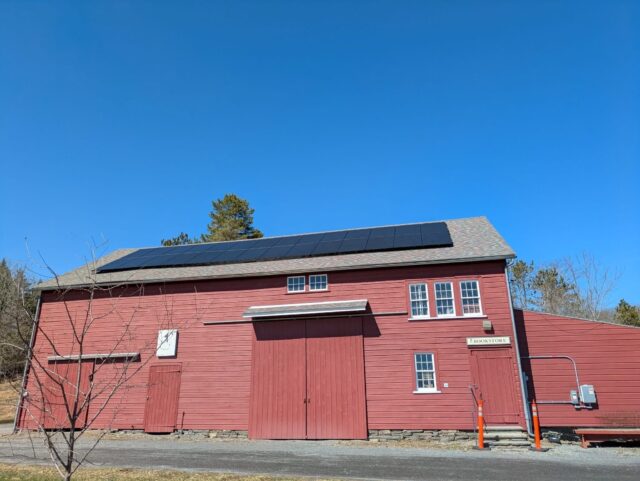
Over the years, the Landis barn has received ongoing maintenance. With support of grant funds from The Nicholas J. Juried Family Foundation, a new roof and solar panels were recently installed, supporting all power needs for the barn, Farmhouse, and Greenhouse.