
It must have been a nice place to sun yourself. Who wouldn’t want to be lying on the beach of a warm, shallow, tropical sea? Perhaps some fern-like trees for shade. Soft, sun-warmed sand to loll in. And perhaps a few trilobites swimming past your toes.
This was the Landis landscape, four hundred million years ago, in the Devonian Period. Unfortunately, these days we have no chance to go sunbathing on the shores of this inland sea. No humans walked this landscape, and no dinosaurs either. The Devonian was about two hundred million years before the dinos. Did dinosaurs ever stalk where the Meeting House now stands? Possibly, but we may never know. This area of New York State was severely scoured by glaciers during the Ice Age, scraping away bedrock that might contain dinosaur fossils —at least none have been found yet.
But let’s dive back into those tropical waters, now known as the Catskill Sea. It was a habitat filled with life. If you put on a four-hundred-million-year-old snorkel and swam out into that warm, salty water, you’d see lots of brachiopods sitting on the sea floor, looking like small, ribbed clams. You’d swim past crinoids, sort of like flowery, tentacled sea anemones on long stems. Sea snails made their slow way through wide coral reefs. Trilobites, those bug-like little arthropods, scuttered across the sea bottom, or sometimes dug through the silt, looking for tasty morsels. Other species of trilobites (apparently there were many different types) would swim, paddling in the shallows or even floating in the open water.
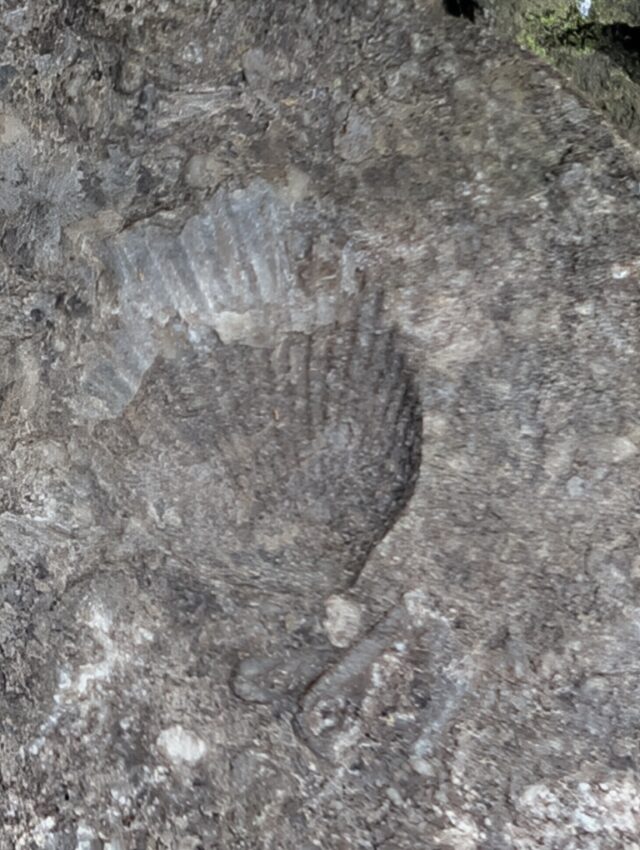
Schoharie County is internationally famous for its fossils, all those little sea creatures that became entombed in the sandy, silty sea bottom. Over a few hundred million years, the silty sea floor was squeezed and compressed into a dark gray limestone, known as the Schoharie Formation. There’s a road cut along Rickard Road in Schoharie that’s widely known as a great place to find fossils—almost any scrap of stone you pick up will have brachiopods or bits of crinoid stems, which look like little stone rings. You might even get lucky and find a trilobite. (Please don’t fossil-hunt on Landis land, though.)
It’s hard for our puny human brains to comprehend the immense sweeps of time that separate us from these little creatures. Four hundred million years: easy to say, hard to comprehend. Once alive and swimming in the sea. And now here they are, preserved in a stone you can hold in your hand.