
When we look at a brown, prickly object attached to the branch of an evergreen tree, we tend to call it a pine cone. But this, of course, is only accurate if the cone is attached to a pine tree. There are almost as many types of cone-bearing trees, or conifers, as there are varieties of ice cream. There are also spruce cones. Fir cones. Cedar cones, sequoia cones, metasequoia cones, larch cones, hemlock cones, juniper cones, cypress cones. And, as my granddaughter observes, mint chocolate chip ice cream cones.
What is a cone, anyway? Why do trees go to the trouble of creating these complex, durable structures? Basically, cones are seed holders, built sturdy enough to protect the delicate seeds inside. An unripe pine cone is bright green, not brown, sticky with resin, the developing seeds covered by overlapping scales. Over the summer the cone ripens, turning brown and woody. When the cone is fully ripe, the scales open so that the seeds that were hidden underneath can be carried far and wide by the wind.
Pine cones, and also fir and spruce cones, don’t open just once. Even after they’ve fallen off the tree, the scales can keep on opening and closing, depending on the weather. They open when the day is dry and close up tight when it’s wet, like umbrellas in reverse. It’s not that the cone knows that wet weather isn’t the best for seeds that need to disperse on the wind. It’s a strictly mechanical process. Humidity in the air makes the wooden scales cells swell and curl inward over the seeds. When the weather turns warm and dry, the cones dry out and open back up, releasing seeds. The seeds are tiny and very lightweight, with a feathery tail attached that helps them glide on the breeze.
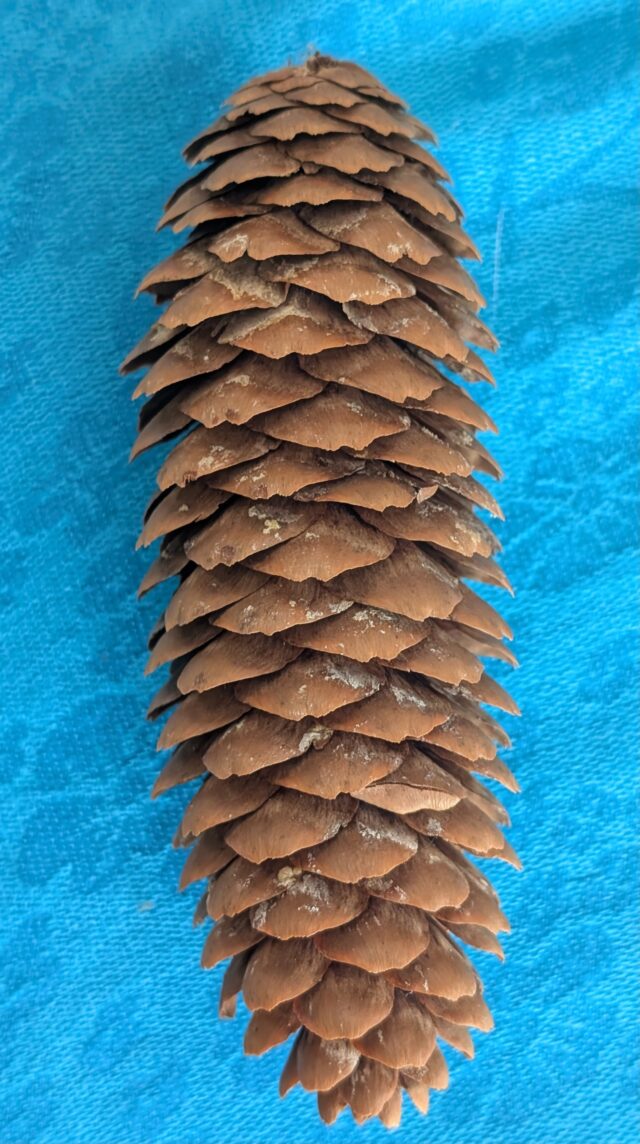
Of course, a huge percentage of those tasty, high-nutrition seeds are gobbled up by a variety of wildlife. Red squirrels especially adore Norway spruce cones. I once watched a squirrel sitting on a branch making short workof a cone almost as big as he was. He deftly nibbled off each scale, spitting it out and letting it fall to the ground. Then he ate the seeds, twirling the cone in his paws as though eating an ear of corn on the cob. When he was finished, he carelessly tossed the chewed core of the cone onto the pile of scales below his branch and started on the next cone. These piles of cone debris, called middens, are often piled two or three feet deep under spruce trees.
Chipmunks, mice, and meadow voles all love the seed bonanza the cones contain. Birds like chickadees, crossbills and woodpeckers eat them too. In a hungry winter like the one we’ve just had, with bitter cold and snow on the ground for weeks, energy-rich seeds can be a survival food for other creatures, like raccoons or deer.
So that’s the scoop (sorry!) on cones—at least from a naturalist’s point of view. But let’s look at a cone from an artist’s point of view. Pick up a pencil and try to sketch a pine cone sometime. It’s almost impossible. I can’t think of anything in nature that’s harder to draw. The deceptively simple cone has an incredibly complicated geometry. The scales are attached to the center in opposing swirls of spirals in a Fibonacci sequence that allows the scales to grow so that they don’t overshadow each other. This elegant pattern allows the cone to utilize space efficiently, in order to maximize the number of seeds it can hold. It’s the same spiral that we see repeated in nature, in sunflowers and seashells and swirling galaxies.
When is a cone not a cone? When it’s a cradle for future trees. Or a winter survival food. Or a work of art.