
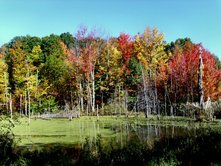
The Woodland Trail takes the visitor to a pond that was, until the construction of a dike in 2008, a seasonal wetland. This now year-round pond is home to many frogs, dragonflies, turtles, and ducks. The green growth that covers the pond’s surface might be mistaken for algae. It’s actually duckweed (Lemna spp,), a high-protein food source for waterfowl considered to be the smallest flowering plant in the world.
Duckweed is a very small free-floating plant that consists of one to three fronds, with a root (or root hair) protruding from each frond. It forms dense colonies in quiet water, often including more than a single species. This co-mingling of species is indicated by different shades of green and is evident in the Woodland Pond.
One curious aspect of the duckweed is its ability to withstand dry conditions or declining temperatures. Late summer flowering produces starch-filled structures more dense than the fronds. The plants then sink to the bottom, become buried in the mud, and rise to the surface in spring. Thus one might consider the duckweed a migratory plant!
Duckweed is being explored for many practical uses. One is a form of ethanol. Duckweed can double its mass every few days. By manipulating conditions during its growing period, its starch content can be increased and later broken down and fermented into ethanol. Since duckweed can be harvested regularly, sometimes daily, it can produce up to four times the ethanol per acre as corn. The use of ethanol does not increase the amount of carbon in the atmosphere. Since plants take in carbon (in the form of CO2 ) as they are growing, the carbon released during burning results in a net balance, while fossil fuels cause a carbon increase as they release carbon that was once stored in the earth.
Duckweed can also be used as a water purifier. As it grows, it has a substantial need for nutrients, especially phosphates and nitrogen and ammonia. As the plant uptakes these elements, it adds them to its biomass. This process filters and cleans sewage and waste water. If toxic pollutants are not present, the duckweed can be skimmed off and used for fertilizer or to feed fish. It can also be used to feed animals, but a retention period in clean water is necessary to ensure that the biomass is free of water-borne pathogens.
The duckweed is truly a small plant with big potential applications, thus proving the old adage that good things come in small packages.