News & Muse from the Bluebird Trail – Bluebird Blog, Autumn 2026 Issue
Please submit any comments, questions, or suggestions to birding@landisarboretum.org.
News from the Trail
Trail monitoring report
If you’d like to follow along with our Bluebird Trail Map, please visit https://landisarboretum.org/maps .
Nest box monitoring began during March and ended in August after our final batch of fledglings took off on the 25th. We had lots of breeding success on the trail, although this year’s numbers were reduced compared to the previous two years. I believe the cause of this decrease was a higher rate of interspecies competition for nest boxes. House Wrens are well known nest raiders. Tree Swallows and Eastern Bluebirds, less so. House Sparrows are infamous for their destructiveness. While House Sparrows aren’t commonly found at the Arboretum, we had the misfortune of one nesting attempt by them this summer, which was accompanied by attacks on several nearby birds. By the time I went to address this issue, I was surprised to find that a House Wren had beat me to it by sneaking into the box and covering the House Sparrow nest with sticks. Afterwards, the House Sparrows were not seen again.
All nest boxes have received an end of season cleaning and inspection. This involved scraping the inside of each box with a putty knife to remove any residue, clearing any blocked drainage holes, checking for rot or other damage, and evicting any mice. (I’m happy to report that mouse nests have become a rarity.) A few leaky boxes will be taken down and repaired or replaced prior to next spring. A second inspection will be carried out in late winter prior to the 2027 nesting season.
It is common for some bluebirds to overwinter at the Arboretum and use our nest boxes for shelter. This fall we plan to modify a couple of boxesto be more cold-resistant by plugging ventilation holes and adding insulation. Hopefully they will find these boxes helpful. I will report back next spring.
During 2026 the Arboretum held many bird-related field trips and classes. We also held our Bluebird Lottery (more information below). Looking ahead to 2027, we expect to offer many of these same events again. If there are other classes or field trips you’d like to see, please email us withyour ideas.
2026 Summary statistics:
Number of Nest Boxes = 42 (21 locations with a pair of boxes at each)
Fledglings:
Eastern Bluebird = 27
Tree Swallow = 22
Northern House Wren = 42
Other = 0
Total (sum of all species):
Eggs Laid = 207
Young Hatched = 130
Fledglings = 91
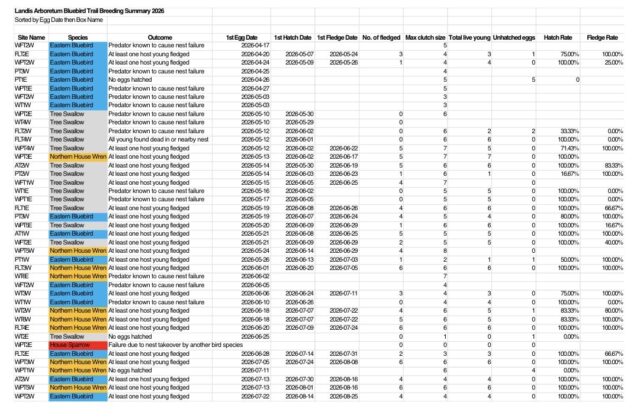
Find more detailed nesting information in the table at the end of this blog edition.
Note that all nest monitoring is conducted in accordance with The Cornell Lab of Ornithology’s Nestwatch Nest Monitoring Manual. All monitoring data is entered into the Nestwatch database, and an end-of-year summary is submitted to the New York State Bluebird Society.
2026 Nest Box Award Winners:

First – The first egg of the year was laid on April 17 in Box WFT2W,Eastern Bluebird.
Last – The last fledgling departed from Box WPT2W on August 25,Eastern Bluebird.
Most – The box with the most fledglings was WPT5W, 10 Northern House Wrens.
Least – While not every nest box pair produced fledglings this year, they all had activity, i.e. at least one nesting attempt.
Ruler of the Roost – More House Wrens fledged than any other species.
Most Unwanted Visitor(s) – House Sparrows (HOSP) built a nest in WPT2E in late June.
People’s Choice Award – Locations AT2 and WPT4 received the most Bluebird Lottery guesses, 10 each. See Nestbox Spotlight below.
Bluebirdiest Boxes – Boxes AT1W, FLT2E and WPT2W each hosted5 fledglings.
Bluebird Lottery summary report
Our lottery is essentially a game where you can submit an educated guessabout which nest box location (pair of boxes) will produce (fledge) bluebirds and possibly win a free membership and other prizes.
This year we had 78 participants submit a guess. Every location received at least one guess except for PT1. Two (FLT2 and WPT2) out of twenty-one locations fledged bluebirds by the June 15 lottery end date resulting in twelve participants winning free Landis Arboretum memberships. Each of these winners were then entered in a drawing for our fourteen grand prizes, which included four $25 gift certificates donated by The Apple Barrel, five subscriptions to The Mountain Eagle/Schoharie News, bird feeders donated by an anonymous benefactor, $20 credit for our plant sale, and free attendance for one of our field trips. Whether you enjoyed the lottery this year or missed out on the fun, stay tuned. We hope to do it again next year.
Featured Bird
House Sparrow (HOSP) – “Without question, the most deplorable event in the history of American ornithology was the introduction of the English Sparrow.” <House Sparrow> -W.L. Dawson, The Birds of Ohio, 1903.
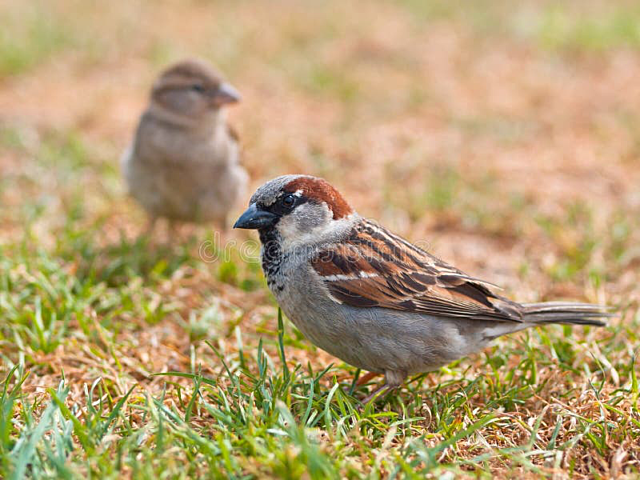
House Sparrows were introduced to North America from Europe in 1851. They benefit from close association with humans and are especially common in cities, towns, suburbs, and on farms. HOSP are very aggressive and it is common for them to destroy the nests and kill the adults of our native cavity-nesting songbirds. It’s not their fault. That’s how they’re programmed. Nevertheless, if you are serious about setting up a box for bluebirds, swallows, or other native songbirds, you should avoid HOSP territory and monitor the box to prevent any HOSP that findit from successfully nesting. This practice is allowable in the case of House Sparrows because they are an invasive, unprotected species. You can learn much more about House Sparrows by visiting https://www.sialis.org/hosp/ .
Muse for the Trail
A human heart can never grow old if it takes a lively interest in the pairing of birds, the reproduction of flowers, and the changing tints of autumn leaves.
- Lydia M. Child
If we think birds, we shall see birds wherever we go.
- John Burroughs
Random Facts and Helpful Hints
More than half of our bird species migrate south during fall. All those that migrate don’t do it the same way. Most birds migrate at night, but hawks and some others migrate during the day. Male Ruby-throated Hummingbirds start before autumn has officially started and some ducks will migrate only as far as necessary to find open water and food. Some bird species travel short distances or simply go from a higher to a lower elevation. Others make long-distance journeys.
Quarterly Boggler
Which bird travels farthest on its annual migration?
(see below)
Nestbox Spotlight
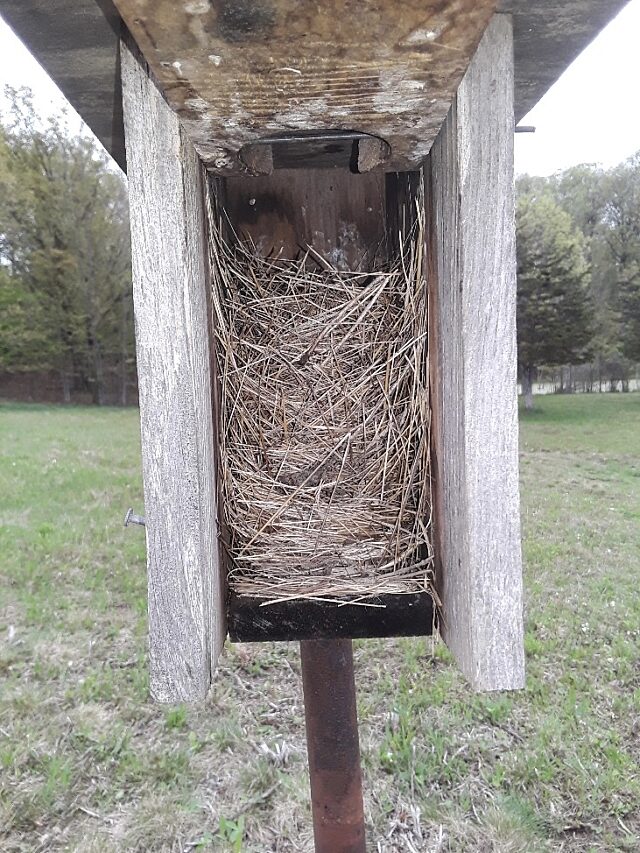
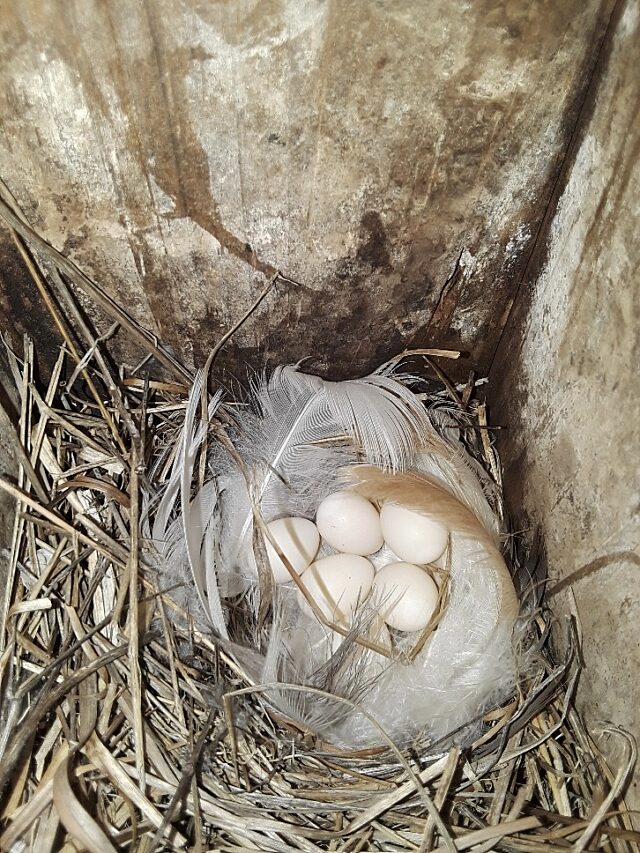
Locations AT2 and WPT4 tied for this year’s People’s Choice Award.
Boggler Answer
The Arctic Tern travels up to 55,000 miles each year from breeding grounds in the Arctic to Antarctica and back. Doing so, it experiences two summers and more daylight than any other animal on Earth.
Bluebird Trail Breeding Summary 2026